
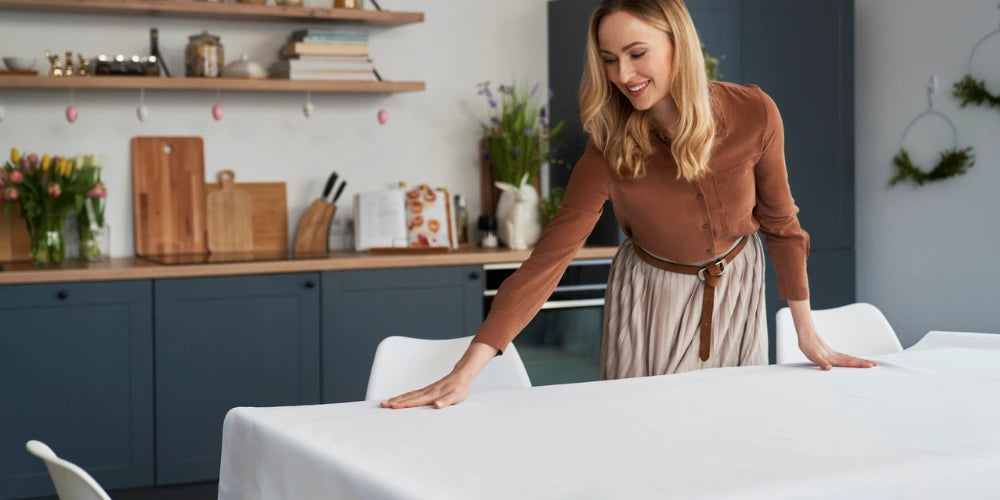
Welcome to a world where function meets art, where protecting your furniture becomes an opportunity to redefine and embellish your interior space. Today we dive into the fascinating world of oilcloths, those practical and attractive tablecloths that do not simply keep your designer tables safe from the hazards of daily life, but also invite you to constantly reinvent your decoration.
Imagine your table for a moment, no longer as a simple piece of furniture, but as a blank canvas ready to receive touches of colour, texture and style. The oilcloth, with its ease of use and variety of designs, gives you that possibility. Whether it is a formal dinner, a relaxed brunch or even a craft activity with the children, the right oilcloth can turn these moments into true aesthetic experiences.
But how do you make the right choice? How do you make sure the oilcloth is not only practical, but also a harmonious complement to your decoration? Follow me through this detailed guide, where together we will explore everything you need to know to make your table a masterpiece.
1. Which size of oilcloth should you choose?
The choice of the size of your oilcloth is one of the most important aspects. An oilcloth that is too small will leave parts of your table vulnerable, while one that is too large will hang over awkwardly, upsetting the aesthetic balance of your space. Here is how to choose the ideal size:

a. Measure precisely
Start by measuring the dimensions of your table. If you have a rectangular or square table, measure the length and width. For a round table, measure the diameter. Remember that the oilcloth must cover the whole surface of the table while offering an elegant drop at the sides.
b. Add the drop
Once you have the dimensions of your table, add 20 to 30 cm to each measurement to allow for the drop. This drop is not only attractive, it also ensures that the oilcloth stays in place, even if it is accidentally moved.
c. Take the shape of the table into account
The choice of the shape of your oilcloth is just as crucial. If you have a round table, opt for a round oilcloth. For square or rectangular tables, their oilcloth counterparts will be perfect. And for oval tables, do not worry: there are also oilcloths designed especially for them.
d. A tip for extending tables
If your table extends, consider having two oilcloths of different sizes, one for the standard size and another for when it is fully extended. This lets you maintain consistent protection and looks, whatever the configuration of your table.
e. The question of styles and patterns
Finally, size is important, but style is just as much so. Choose an oilcloth that harmonises with the rest of your decoration. Whether you like bold patterns, plain colours or subtle designs, there is an oilcloth for every taste.
If your dining room has a minimalist, modern look, opt for neutral shades or simple geometric patterns. For a more traditional or rustic space, floral patterns or warm colours can add a touch of warmth and friendliness.
f. The importance of the fabric
The material of your oilcloth also needs to be taken into account. PVC oilcloths are excellent for everyday use because they are easy to clean and resist stains well. For special occasions, you might prefer an oilcloth with a fabric coating for a more refined look. Think about thickness too: a thicker oilcloth will offer better protection against knocks and scratches.
g. Think about how often you will use it
Your choice may also be influenced by how often you use it. If your table is used daily for family meals, a more resistant, easy-to-clean oilcloth will be ideal. For occasional use, you can opt for more decorative and delicate options.
h. Storage tips
Also think about how you will store your oilcloth when you are not using it. Folded oilcloths can crease and take time to smooth out again once unfolded. Rolled storage is often preferable for keeping the oilcloth in good condition.
With these tips, you are now equipped to choose the perfect oilcloth for your table. Keep in mind that the oilcloth is not only protection; it is an element of your decor, a reflection of your personality and your lifestyle. So choose with care and let your table tell its story.
By following this advice, you will be able to choose the perfect oilcloth, not only to protect your table, but also to complement the mood of your home. Whether for an intimate dinner, a family party or simply to brighten up your everyday space, the right oilcloth can make all the difference. Enjoy choosing, fitting and using your oilcloth, knowing that it helps make every meal a little more special.
2. How do you fit an oilcloth tablecloth?
Fitting an oilcloth is not just a practical matter, it is a true art of the table. Here is how to go about it for a result that is both attractive and effective:
Unrolling and positioning
Open the oilcloth and spread it gently over the table. Start by lining up a corner or the centre (for round tables) and unroll it gradually. Make sure the oilcloth is well centred, with an even drop on all sides.

Smoothing and adjustments
Once it is in place, smooth the oilcloth from the centre towards the edges to remove any creases. This not only improves the look, but also ensures that the oilcloth sits well on the surface of the table. For tables with rounded edges, make sure you adjust the oilcloth so that it follows the curves perfectly.
Securing the oilcloth
To keep the oilcloth in place, especially if the table is used often or if you have children, use special tablecloth clips. These discreet but effective accessories ensure that the oilcloth does not slip, while preserving the look of your table.
The aesthetic role
When fitting your oilcloth, think about its aesthetic role. It can serve as a neutral base to show off your tableware and table accessories, or be a decorative element in its own right with bold patterns and colours. Fitting the oilcloth is therefore a key step in setting the mood of your meal.
3. Which side of the oilcloth should face up?
Choosing the right side of the oilcloth to display is crucial both for protecting your table and for the look of your space.
Identifying the right side
Generally, an oilcloth has a shiny side and a matt side. The shiny side is often more colourful, sometimes with decorative patterns or textures. This is the side meant to be seen, and it provides the aesthetic touch. The matt side, for its part, is designed to be in contact with the table. Its slightly rough texture helps keep the oilcloth in place and effectively protects the surface of the table.
The importance of protection
The correct orientation of the oilcloth is essential to maximise its protective function. The matt side, being in contact with the table, prevents scratches and damage caused by liquids, heat or sharp objects. This is particularly important for tables in wood, glass or any other delicate material.
Aesthetic considerations
Although function is important, the look is just as much so. The decorative side of the oilcloth should harmonise with the rest of your table and dining room decoration. Whether you opt for a classic, modern, country or flamboyant look, the right side of the oilcloth will help create the mood you want.
Tips for ideal placement
When you lay the oilcloth, make sure it is smooth and free of creases, which will improve not only the look of your table but also the durability of the oilcloth itself. Careful placement ensures that the oilcloth does its job while adding a touch of elegance to your space.
By following these tips for choosing the right side of the oilcloth and fitting it correctly, you ensure not only optimal protection for your table, but also aesthetic harmony in your living space. The oilcloth thus becomes more than a simple tablecloth: it becomes a key element of your decor, reflecting your style and your attention to detail. Whether for everyday use or for special occasions, a well-chosen and correctly fitted oilcloth can make all the difference, bringing both function and beauty to your table.
In short, fitting an oilcloth is a simple but significant act, combining protection and decoration. It is an invitation to see your table in a new light, to turn it into a useful work of art that enriches the moments you share around it. With this advice, you are ready to choose, fit and enjoy your oilcloth, knowing that it contributes to the beauty and longevity of your living space.
4. Can an oilcloth be machine washed?
Looking after an oilcloth is an essential matter for preserving its look and durability. Unlike traditional fabric tablecloths, an oilcloth has particular cleaning requirements that are important to know.
Hand washing preferred
An oilcloth, because it is made of PVC or a similar material, is generally not suitable for machine washing. The washing machine process, with its agitation and heat, can damage the material, leading to cracking or discolouration. We therefore advise cleaning the oilcloth by hand.
Effective, gentle cleaning
To clean your oilcloth, use a soft cloth or sponge, lukewarm water and, if necessary, a little mild soap. Wipe the surfaces with care, paying particular attention to stains. Avoid using abrasive cleaning products or metal scourers, as they can scratch or damage the surface of the oilcloth.
Air drying
After cleaning, leave your oilcloth to air dry. Avoid putting it in a tumble dryer or near direct heat sources such as radiators. Natural drying will preserve the quality and shape of the oilcloth.
Preventing stains
To reduce how often you need to clean, take precautions to avoid stains. For example, use coasters or place mats to protect the oilcloth from food and drink stains. Small preventive measures can greatly extend the cleanliness and durability of your oilcloth.
5. How should you store your oilcloth for maximum durability?
The way you store and look after your oilcloth has a significant impact on its durability. Here are a few tips for keeping it in the best possible condition:
Storing without folding
To avoid permanent creases or cracks, do not fold your oilcloth. Instead, roll it gently around a cardboard tube or a reel. This helps keep its shape and prevents unwanted marks.
Protecting from UV
An oilcloth can be sensitive to UV rays, which can alter its colours and texture. When it is not in use, store it in a dry place, away from direct sunlight. A wardrobe or a drawer can be an excellent choice.
Avoiding extreme temperatures
Extreme temperature variations can affect the composition of the oilcloth. Avoid storing it in places that are too hot or too cold, such as an attic or an uninsulated basement. A stable room temperature is ideal for preserving the elasticity and colour of the oilcloth.
Controlling humidity
Humidity can be another enemy of the oilcloth, potentially leading to mould or unpleasant odours. Make sure the storage place is dry enough. If necessary, use dehumidifiers or moisture-absorbing sachets to keep the environment dry.
Cleaning before storing
Before putting your oilcloth away, make sure it is clean and completely dry. This prevents the build-up of bacteria or mould during storage. Regular upkeep ensures that your oilcloth stays in optimal condition, ready to use at any time.
Regular inspection
Even when it is not used often, inspect your oilcloth periodically for any sign of wear or deterioration. This will let you step in quickly if there is a problem and extend the life of your oilcloth.
By taking care of your oilcloth, you not only ensure lasting protection for your table, but also maintain the visual appeal of your living space. A well-maintained oilcloth is an asset to your interior decoration, offering both function and style.